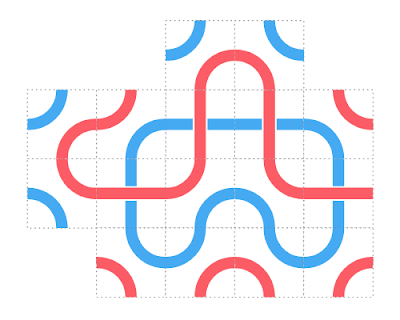
Serpentiles allow the creation of richly patterned or random-seeming mosaics from relatively small tilesets. Here we'll take a look at a couple games that make use of a simple set and their colored variant.
A nice source of generalizations for classic games played on a tabletop is porting them over to other surfaces. Today we'll look at Tic Tac Toe on more exotic surfaces than the standard \(3 \times 3\) board.
In order to spice up classical combinatorial games, mathematicians have explored what happens if, instead of alternating turns, players bid each turn for the opportunity to make a move. Here we'll look at Tic Tac Toe with such a bidding scheme.
Combinatorial game theory is a deep well to draw from in the math enrichment world. JRMF has Apple Picking , Countdown , Rook's Move , and Sprigs on the books. I thought we'd look at the classic Grundy's Game and a few variations. I'll take this as an opportunity to introduce a few concepts useful in analyzing combinatorial games, more broadly.
There is a healthy number of turn-based dice games with a press-your-luck element such as 10,000, Farkle, and Greed. Here is a variant that keeps the numbers smaller and probabilities simpler in order to make the arithmetic and analysis more tractable for younger audiences.
In this activity, students design bingo cards based on their impressions of which sums will come up first and most often when two dice are rolled repeatedly. This activity is a nice introduction to discrete probability distributions and some of their conceptual pitfalls.