Posts

Grundy's Game

Image
Combinatorial game theory is a deep well to draw from in the math enrichment world. JRMF has Apple Picking , Countdown , Rook's Move , and Sprigs on the books. I thought we'd look at the classic Grundy's Game and a few variations. I'll take this as an opportunity to introduce a few concepts useful in analyzing combinatorial games, more broadly.
Nested Polyhedral Frames

Image
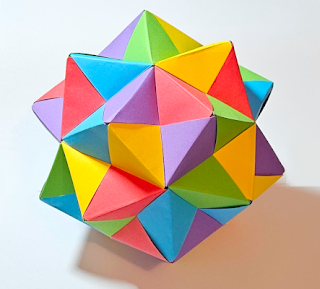
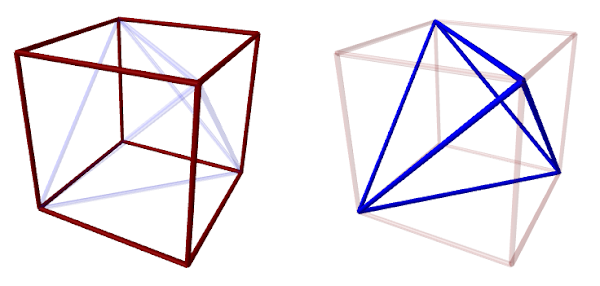
Glen Whitney and Alex Kontorovich are putting together a mathematical art expo visualizing Euler's formula for polyhedra, with polyhedra placed at their respective \( (v,e,f) \)-coordinates to form the plane \( v-e+f = 2 \) in 3-space. I thought we would look at another polyhedron construction method and hopefully end with something we can ship their way!

Polyomino Tiling Recurrences

Image
One of the struggles at JRMF has been finding arithmetic activities that are as popular as our logical and geometric activities in a festival setting. Kids see an activity table with numbers and tend to want to flock to the other tables. I don't think the activity I'll present today is a great festival activity as-is, but I like it because it deals with recurrence relations disguised as a geometric problem. I've run it over the years and my colleague Steve Heller has a well-loved version he has dressed as brick-laying on the Yellow Brick Road. Math circle kids love it, but our goal with math festivals is to give kids that don't normally end up at math circles a bite-sized version that invites -- but doesn't demand -- a ton of careful handwritten work. The reasons I'm hesitant to think of this activity as a great festival activity are (1) there's a some book-keeping required to arrive at the arithmetic content, which younger students don't often th...

Paradromic Rings

Image
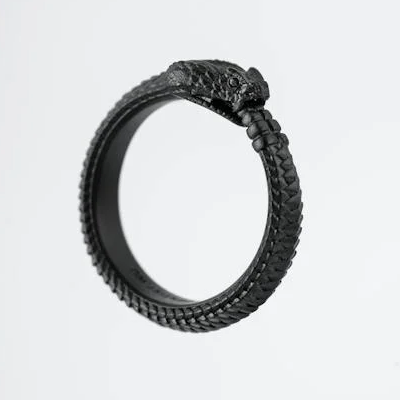
There are a number of activities based on Möbius bands in recreational mathematics lore. Here we'll look at a variant with some topological and number sequence aspects.

Modular Origami with Sonobe Units

Image
The other month, I volunteered at Seattle Universal Math Museum's corner of Free First Thursdays at the Museum of Flight. Part of this was helping kids make origami paper airplanes, which reminded me of some origami challenges I used to give students. I'll present one of my favorite arcs here.

Rigid Frameworks

Image
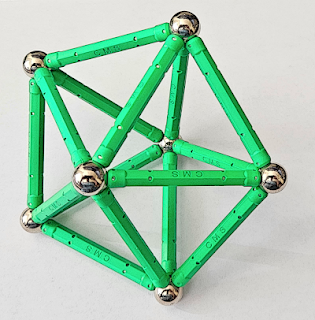
My colleague Gabriella Pinter presented a neat 2D rigidity activity at JMM this January that I might write about later, but it reminded me of a 3D rigidity exploration that I've enjoyed running over the years.

Word Grids

Image
I try to design activities every once in a while that have a tie-in to another discipline. Here we'll look at a collection of puzzles that are superficially about words but are more about geometry and arithmetic once you start looking for strategies.

Greed

Image
There is a healthy number of turn-based dice games with a press-your-luck element such as 10,000, Farkle, and Greed. Here is a variant that keeps the numbers smaller and probabilities simpler in order to make the arithmetic and analysis more tractable for younger audiences.

Self-Reference Puzzles

Image
As an undergraduate, I stumbled upon Jim Propp's Self-Referential Aptitude Test and spent a couple hours working on it. That experience stuck with me and I have since made smaller-scale versions and variants for students. This is a hard activity to pin down to an age group, but it can skew a little more abstract and occasionally arithmetic, so I'd peg it around 7th grade and up but have definitely had some luck with advanced elementary school children.

A Colored Loops Extension

Image
This problem was sparked by a question asked by a student in the JRMF Community Math Circle featuring Colored Loops, an activity based on Gord Hamilton's Stirring Paint.   While it can be used an an extension to Colored Loops, I'll present it as a stand-alone activity.